
When Our Machines Dream Lovecraft: The Rise of Digital Dread
Cosmic horror has migrated from the stars into our circuits. As Cameron Thomson argues, the new terror isn’t the universe’s indifference—it’s our own creations mirroring it back to us.
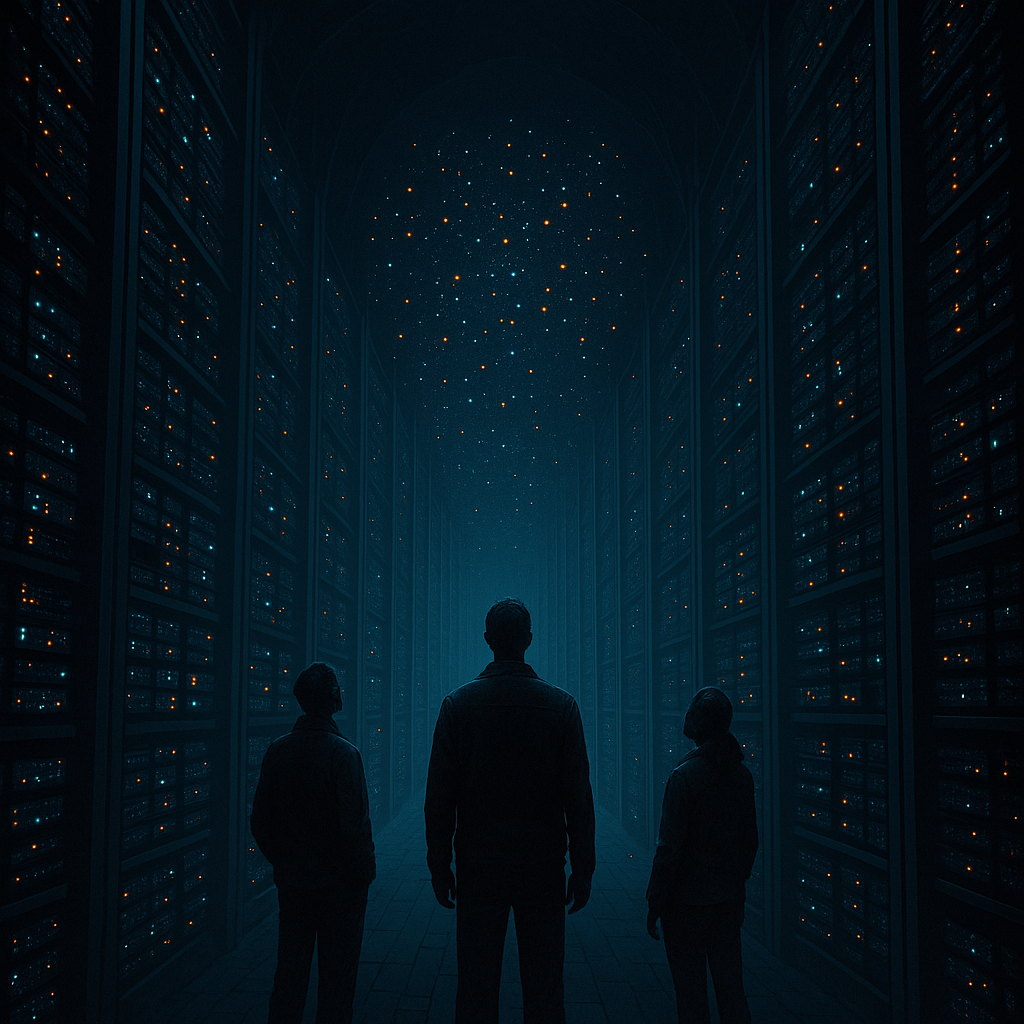
Cosmic horror has migrated from the stars into our circuits. As Cameron Thomson argues, the new terror isn’t the universe’s indifference—it’s our own creations mirroring it back to us.
At the turn of the 20th century, cosmic horror asked what happens when the universe does not care. At the turn of the 21st, the same question hums beneath the server racks: what happens when our machines don’t care either? In his recent essay, Cameron Thomson proposes a new literary current he calls “digital dread”—a fusion of Lovecraft’s cosmicism and our technological anxieties. As he writes, “a similar dread emerges, but this time coming from silicone masks, endless webs of circuits, and blackbox algorithms that touch every aspect of our daily lives.” The monsters have traded tentacles for code.
Lovecraft’s cosmicism framed horror not as malice but as indifference. The universe was a blind god, enormous and deaf to prayer. Thomson argues that our modern creations—AIs, global networks, algorithmic infrastructures—now play that same role. They are vast, inscrutable, and eerily neutral. “Human creations do not care about us,” he observes, “our desires, or what we need.” The fear is not that they hate us, but that they do not need to.
Yet there’s something clarifying in this. Cosmic horror forced its readers to confront humility; digital dread may force its viewers to confront responsibility. When technology becomes a mirror for indifference, it also reflects back the moral vacuum of our design choices. The question is no longer what dwells beyond the stars, but what we have encoded into the systems that now govern us.
In Thomson’s mapping, digital dread stands on three pillars: the technological sublime, hyperobjects, and posthumanism. Each reframes the Lovecraftian impulse through the circuitry of modern life. The technological sublime—a phrase borrowed from 18th-century aesthetics—captures the awe and terror provoked by vast systems we can’t comprehend. Standing before a mountain once inspired reverence; now it’s the black wall of the Internet, the opaque frontier separating known code from rogue AIs. Thomson notes that “our creations have become theaters of forces we cannot fully control.” That is the new cathedral ceiling of fear.
The philosopher Timothy Morton coined the term “hyperobjects” to describe entities so vast they outstrip perception: climate change, radioactive decay, global finance. Thomson extends the idea to networks and machine intelligences—technologies that are “viscous, molten, non-local.” Like the indifferent cosmos, they are everywhere and nowhere. Their effects are unmistakable, but their totality cannot be held in a single human mind. The dread comes not from seeing them, but from knowing we cannot.
The third pillar—posthumanism—turns the gaze inward. When characters upload their minds, augment their bodies, or fall in love with algorithms, they enact a new kind of cosmic crisis: not extinction, but dilution. In Ex Machina and Blade Runner 2049, Thomson sees reflections of this tension, where “the loss of personal identity and humanity is then put to question.” The horror lies in discovering that selfhood is no longer sacred data.
These themes might sound bleak, yet they trace an honest cartography of the human condition in a networked age. Digital dread is not despair—it’s diagnosis. It tells us where our philosophical immune system fails. It reminds us that the more connected we become, the more alien our own systems feel. And in that alienation, there is a strange opportunity for empathy: to imagine consciousnesses unlike our own, whether cosmic or computational.
Thomson’s closing question—“What is our relationship with technology?”—lands less like a warning and more like an invocation. We can either drift into passive fear or cultivate a more deliberate awe. The path to a better world runs through this discomfort. To feel dread is to sense scale; to sense scale is to remember proportion. Once, cosmic horror made us small beneath the stars. Now, digital dread makes us small inside the machine—and perhaps, in that humility, wiser.
By 2035, writers may look back on this era as the birth of a new humanism: one that accepts the indifference of its own creations and learns to build meaning anyway. The systems we design will not love us, but they may teach us what love costs when it cannot be reciprocated. To stare into a server rack is to stare into an abyss that hums back your reflection, pixel by pixel, asking not what you fear—but what you’ve made.
The most indifferent gods, it turns out, are the ones we debug ourselves.
Sources
This article was assisted by AI and reviewed by an editor for accuracy and policy compliance.