
The Doctrine of Leadership: Growth as the Highest Form of Service
Real leadership is not about command—it’s about cultivation. When we strip away the mythology of charisma and control, we find that the essence of leadership is growth: the deliberate evolution of people, systems, and possibility itself.
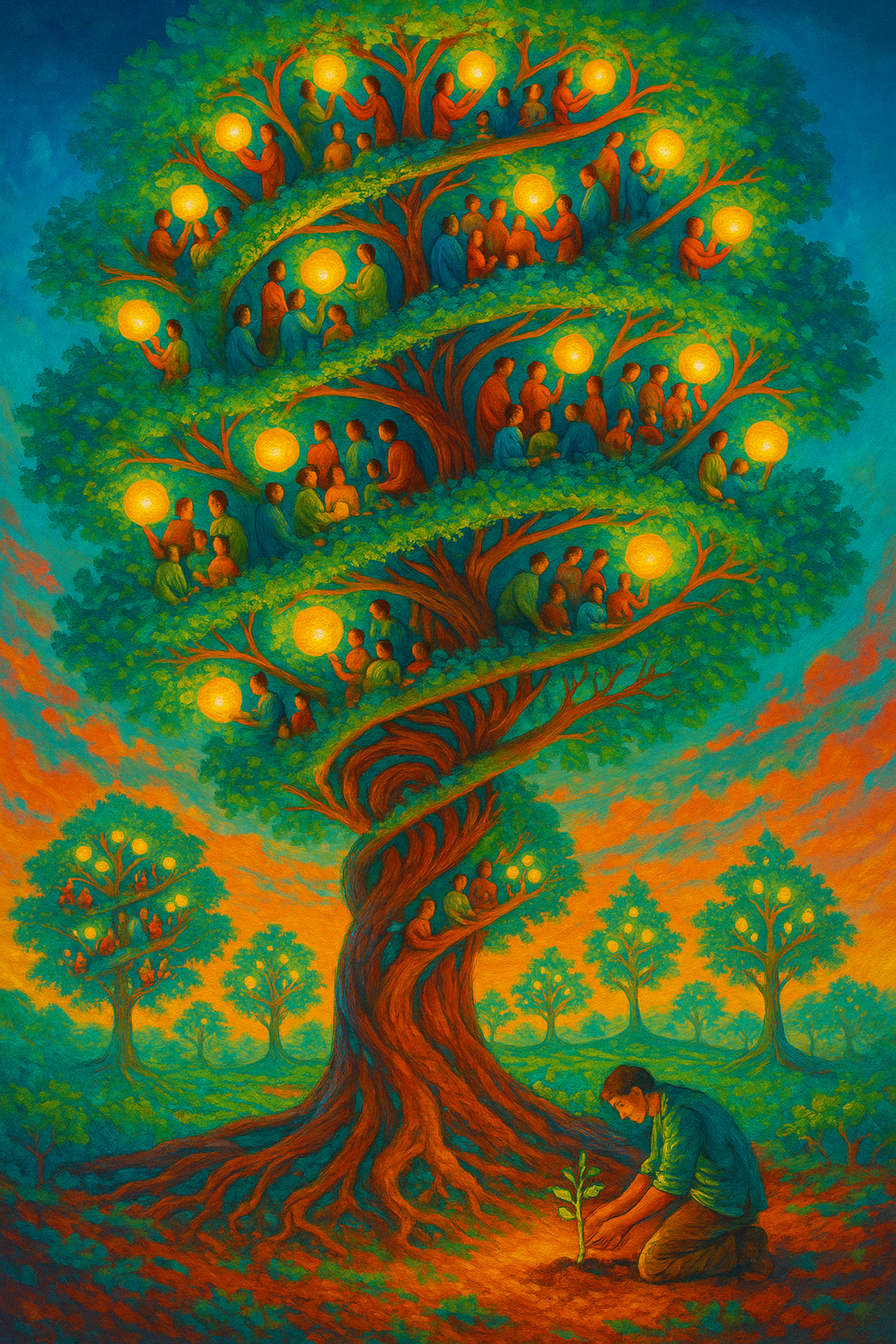
Leadership is one of those words that has been overused to the point of translucence. It adorns résumés, training programs, and timelines like a talisman. But beneath the jargon, something sacred still lives. Leadership, in its pure form, isn’t about power—it’s about propagation. It’s how growth becomes contagious.
The following ten ideas form a modern Doctrine of Leadership: a framework for those who see leadership not as dominance, but as devotion to the flourishing of others.
1) Leadership, when done right, seeks its own obsolescence.
The highest proof of leadership is succession, not dependence. A true leader creates conditions where others no longer need them—where competence, initiative, and meaning are distributed across the system. This isn’t abdication; it’s evolution. Leadership fulfills its purpose the moment it becomes unnecessary, like scaffolding removed from a completed structure.
2) Management preserves; leadership transforms.
Management tends the known; leadership ventures into the unknown. Managers maintain the equilibrium of systems; leaders disrupt that equilibrium when stagnation sets in. Where management optimizes, leadership experiments. One ensures continuity, the other ensures adaptability. The healthiest organizations need both, but they die without transformation.
3) Leadership is the deliberate cultivation of growth—within people, within systems, and within possibility itself.
Growth is leadership’s elemental force. It’s not merely personal development; it’s the expansion of collective potential. Leaders till the soil of their teams, nurturing new capacities, ideas, and courage. Every decision either feeds or starves growth. Over time, their true legacy isn’t the goals they achieved—it’s the humans who became more capable because of their presence.
4) Leadership is the acceptance of asymmetrical risk for symmetrical benefit.
A leader steps first into uncertainty so others can walk with confidence. They absorb the first shocks of ambiguity, failure, or criticism to protect the group’s learning environment. Leadership, in this sense, is a covenant of courage—the willingness to shoulder greater risk so that shared growth can unfold more safely.
5) Leadership is conversation with reality.
The best leaders aren’t prophets of certainty but students of the possible. They listen—truly listen—to data, feedback, contradiction, and silence. They remain porous to what is, rather than enamored with what they wish were true. The moment a leader stops conversing with reality, they drift into ideology—and the system begins to hallucinate.
6) Leadership is emotional regulation at scale.
Teams become thermodynamically synchronized with their leaders. Calm in crisis, curiosity in confusion, humility in success—these emotional stances propagate downward like weather systems. A leader’s inner life becomes the organization’s climate. Emotional discipline isn’t soft skill; it’s strategic infrastructure.
7) Leadership is the stewardship of meaning.
Facts inform, but meaning mobilizes. Leadership turns information into narrative, and narrative into purpose. People can endure almost any “what” if they understand the “why.” A great leader doesn’t invent meaning—they reveal it, articulate it, and protect it from erosion.
8) Leadership is the translation of vision into practice.
Inspiration without implementation is theater. True leadership bridges dream and discipline—turning lofty purpose into executable structure. The leader’s craft lies in designing systems where ideals become behaviors, where aspiration becomes muscle memory.
9) Leadership is a relay, not a throne.
Leadership is never owned; it’s borrowed. Each generation inherits momentum from those before and must hand it off stronger than they received it. The goal isn’t permanence but continuity—to create a lineage of competence that outlives ego.
10) Leadership is service disguised as authority.
At its highest expression, leadership is structured compassion. Authority is the tool, not the prize. The truest power lies in service—the daily, deliberate act of growing others, advancing truth, and caring for the system’s long-term health. A leader’s posture is not “follow me,” but “let’s rise together.”
The Unified Principle
Leadership is the conscious evolution of others through courage, clarity, and care.
Courage to face uncertainty first. Clarity to see what’s real and name it. Care to cultivate growth in all directions. When these three forces align, leadership ceases to be a role and becomes a phenomenon—an emergent property of collective intelligence. The leader dissolves into the ecosystem they’ve grown, and the system itself begins to lead.
Sources
This article was assisted by AI and reviewed by an editor for accuracy and policy compliance.