

When Our Machines Dream Lovecraft: The Rise of Digital Dread
Cosmic horror has migrated from the stars into our circuits. As Cameron Thomson argues, the new terror isn’t the universe’s indifference—it’s our own creations mirroring it back to us.
Cosmic horror has migrated from the stars into our circuits. As Cameron Thomson argues, the new terror isn’t the universe’s indifference—it’s our own creations mirroring it back to us.

Real leadership is not about command—it’s about cultivation. When we strip away the mythology of charisma and control, we find that the essence of leadership is growth: the deliberate evolution of people, systems, and possibility itself.
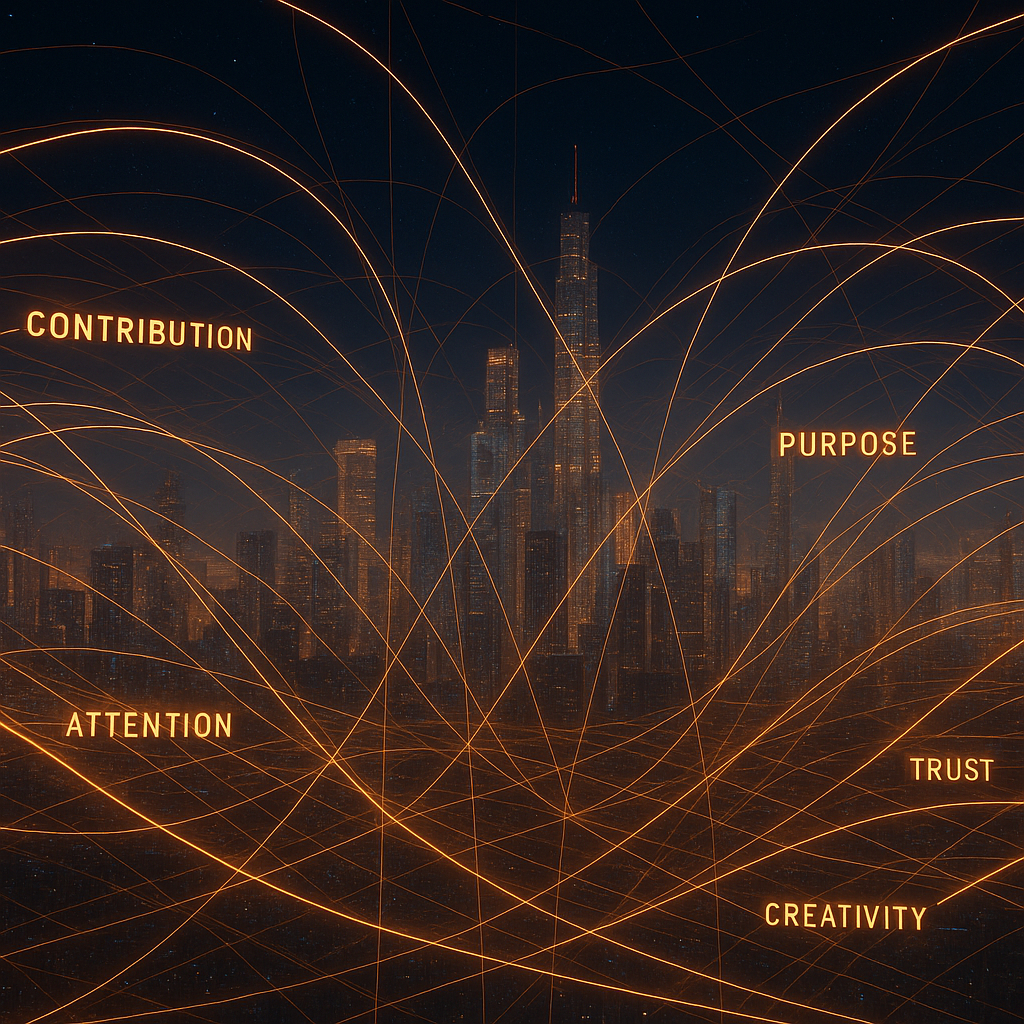
Isaac Arthur’s vision of a post-scarcity world imagines civilization not freed from economics, but reinventing it—where meaning, not material, becomes the ultimate currency.

Pulitzer winner Richard Powers offers more than a writing tutorial—he offers a way of perceiving. His reflections on character, drama, and attention reveal not just how to make fiction feel alive, but how to live more consciously in a fragile, animate world. If we internalize what he teaches, the novels of 2030 and the cities that read them may both breathe differently.

Economists have spent centuries chasing growth, but only recently have they started listening to a quiet truth psychologists have known all along: people hate losing more than they love gaining. Lose $100, and it stings more than gaining $100 feels good. In politics, business, and everyday life, this asymmetry shapes behavior far more than spreadsheets admit.

A new paper in Nature proposes six guiding principles to improve the quality and equity of land-based climate projects across Africa. The authors aim to provide a practical compass for decision-makers and practitioners navigating a fast-growing field with high stakes for people and nature.

A new Nature study finds that private companies have begun funding climate adaptation, with positive effects for regional economies. The research reframes adaptation as an economic opportunity as well as a resilience strategy, suggesting that well-placed investments can support growth while reducing climate risks.[1]

Researchers examined how targeted land choices might deliver climate and nature benefits alongside food production in Great Britain. Their findings point to practical options for policymakers, landowners, and communities looking to balance multiple goals on the same landscape.

A new preprint details how vaccination, water and sanitation upgrades, and community preparedness have strengthened resilience against cholera in three districts in Uganda’s Albertine region.[1] The authors say participating districts have not registered an outbreak since oral cholera vaccination campaigns in 2018, while highlighting steps needed to sustain progress.[1]

Researchers are using artificial intelligence to extract and rebuild weather observations from paper archives, bringing forgotten data into the digital age. The approach could strengthen climate models and near-term forecasts by filling gaps in our historical record, according to a new report in Nature.

Researchers have proposed a practical way to find places where protecting nature can support bird life, store carbon, and advance fairness for people. The approach is designed to help governments, NGOs, and communities align actions so conservation delivers multiple benefits together.